Showing posts with label Studio Defined. Show all posts

Tuesday, October 18, 2011

Content Studio

October Studio Work:

Out of the mouths of students ~ in response to the question, "Why studio?"

  • Observing us and how we think and work will help with their teaching.
  • Teach teachers to learn new ways of teaching.  They learn new strategies.
  • Create more alignment because they see other people teaching. (Mother is in studio work at the high school.)  If this doesn't happen, people are teaching really differently.
  • All are grasping onto what other teachers are doing.
  • So teachers actually study and see how we learn.

What is studio work?  From the point of view of IFs:

  • Work that lowers personal opinion and gathers evidence/data around a problem.
  • We can see our problems more clearly outside of their "natural environment"
  • Answers the questions:
    • How do we get students from A to B?
    • How do we know they are there?
    • What are we thinking now?
·        
OUR FIRST CONTENT STUDIO had 2 Focuses:  Student Talk and Text Demand

STUDENT TALK:
Increasing student talk through Pose, Pause, Pounce, Bounce:

  • Pose - Why ask questions?  To quote the students when they were talking about their writing.  By writing in a way that causes the reader to ask questions, you make them want to read on.  "Questions keep us reading."  By extrapolation, by teaching in a way that causes students to ask questions, you make them want to learn.  Possible:  Questions keep us thinking.  2 reasons to ask questions:  reveal thinking and push thinking (don't let them get away with cliche, easy answers).  REAL questions are worth talking about.  If there is one answer, give them the answer and have them talk about, justify that answer.
  • Pause - Why pause?  Increases access to the conversation.  There are many ways to pause:  think, talk, write  This is a perfect time to formatively assess.  Listen in on conversations - give students status for their thinking and reasoning with each other. Be purposeful about the amount of time you give.  Too much reduces the urgency to talk.  Too little doesn't allow for talk to be meaningful and may create a lack of equity - only time for one person to talk.
    • What if I already had an answer?  Think of another way to phrase it, consider using academic vocabulary in your answer, justify your thinking, etc...Take your understanding further.
    • What if I don't know?  Ask questions.  What answers do you need?  Ask the questions to get those answers.  You can also review your notes, book, word walls, etc.
    • What if I'm close to figuring it out?  Try out an answer, ask a question, review your notes, etc.
  • Pounce - Why Pounce?  Raises accountability.  There are many ways to pounce:  writing (exit ticket), partner talk, group talk, whole class talk, random (sticks, numbers), calling on kids... NO HANDS!  How you pounce should be purposeful and deliberate.
  • Bounce - Why Bounce?  Students have to listen to each other.  Students are learning from each other.  This creates a classroom environment and culture that has many teachers! How to bounce? add on OR ask questions.  (Great article about Academic conversations)  You are formatively assessing more students!  Students are elaborating, not the teacher!
Lara's lesson:
  • Redefine student roles.  "What does it mean for you if I'm teaching differently?  What are you going to have to do now?"  Student responses:
    • Questions make me think!
    • The teacher will know what you understand and don't if you can't explain it more.
    • You get to hear it explained a different way.
    • Usually she couldn't help us until after the quiz, but then we were moving on.  Now she will hear us earlier.  If we are pretending to understand, she'll find out before the quiz.
    • We'll want to learn more because our friends will be involved.
    • We have to come to learn.
    • We have to pay attention in class.  I'll get ready in case I'm called on.
    • You have to be more focused because she could call on you any time.
    • It is easier to pay attention because you have to.  You will participate.
    • Learn more all the time.
    • When I think more, I remember it longer.
    • It is not easier because I"m thinking harder, but it is easier because I'm participating more.
    • I'll like it.
    • Struggling makes us smarter.  Just hearing it doesn't always make sense.
    • I'll have to think deeper instead of just have my first answer.
    • We'll figure it out and use our time more wisely.
    • Use my partner to help me learn - I won't feel all alone.
    • We would have to listen to each other.
    • No matter how smart you are, there is more ways to think about it.
    • It's different than knowing or memorizing it, now you have to talk about it.
    • It's more interesting because it's not about one answer.
    • It might be more embarrassing - I might not know.  (Goal:  shift from knowing to thinking!)

TEXT DEMAND:
What students said made the text 
EASY:
  • words were easy, understood it
  • middle school kids
  • like the weird topic - it was interesting
  • I have PK for this topic.
  • I read it once to understand and then reread if to find the Scientific Method
  • Easier to read with pen in hand!
  • Cue words make it easy to find the Scientific Method - words like "wondered" and "guessed."
HARD:
  • some words were hard - academic/science vocabulary
  • Names were weird
  • Some words were used in a different way
  • Words weren't defined in the text
  • TASK - you had to think deeply to do it.  "Coding and commenting makes an easy text harder to read." - PEAK student.
  • Structure of the article (chronological) did not match of the scientific method (sequence).
Why Code the TEXT? - What is the value of coding our reading?
  • T:  When we name something (find and label it) in our reading, it's easier to replicate it in our writing.  If you can name it, you are more likely to replicate it.
  • Easier to read because you are paying attention.
  • It's more interesting because you are reading AND looking for something (Scientific Method)
  • Helps me learn.
  • Helps me be a better writer.   It will help me write using these things.  Gives me a lot of examples.  It inspires me to use the techniques.  It will make my writing more complex.  (Both RAD and TLH codes will help with writing.)
  • Helps me think more critically about my reading.
  • It gives the reading depth.  
  • I have to use multiple modes of thinking while reading.
  • Without doing this, I might miss important things.
  • Helps me break down harder text

Studio Bests:

Best line:   "____, can you take that out of your nose?"

Big Take Aways:
  1. To understand, human being must reflect and communicate.  PPPB allows for this.
  2. We saw students using word walls/anchor walls to help them with their thinking.  They not only gave access to kids who were struggling, they provided depth to kids who were advanced.
  3. Common goal: be purposeful about how we are grouping kids.  When do we use heterogeneous groups and when do we use homogeneous groups?  Why? 
Questions to consider:
  1. When we hear answers that are new or different or wrong, what do we do?  (Push:  When we hear the wrong answer, this is an opportunity to teach, to develop curriculum!)
  2. Instead of "Do you like ____,"  try "How does ____ help?"  This is similar to Amy's practice of having kids evaluate which activities helped them to learn and which they enjoyed.  (Push:  We want kids to be more cognizant of how strategies are helping them instead of what they like doing.)
  3. Who do students look at when they are sharing?  The teacher? Other students?  What does this say about the locus of control in the classroom?


Sunday, April 18, 2010

CEL Roles and Schedule

~ CEL Website ~


STUDIO TEACHERS - "Job Description"
Qualities: Studio Teachers should...
  • Be good at their craft
  • Be learners
  • Be able to shift and change practice quickly
  • Be student centered
  • Have a good relationship with colleagues
  • Have transferable skills that can be leveraged
  • Be able to articulate thinking and decision making
  • Have leadership capacity

CEL Focus for Studio Teams:

  • Shared teachers' practices: How do we teach reading and thinking about reading instruction?
  • Shared student practices and strategies: What does student work look like? What does proficiency look like?
  • Collaboration: Create shared collaboration structures and capacity. We will create and support studio teams, each studio classroom will team with a SpEd or ELL teacher. Collaboration serves the purpose of creating equity of access for all students.

Studio helps us to elevate our shared understanding...which then elevates our shared practice.

NRC:  "...experts have acquired extensive knowledge that effects what they notice and how they organize, represent, and interpret information in their environments.  This, in turn, affects their abilities to remember, reason, and solve problems. ...expert knowledge serves to create a habit of critically analyzing evidence."

RESIDENT TEACHERS - "Job Description"
Qualities: Resident Teachers should
  • Be good at their craft
  • Be nonlinear thinkers - They can watch a lesson and apply it to their own room.
  • Be learners - They are able to shift and change practice.
  • They are able to articulate thinking and decision making.
  • Be willing to be involved and ask questions. They cannot sit in the back of the room!
  • Be student centered
  • Have good relationships with colleagues
  • Have leadership capacity
CEL focus for Resident Teachers:
  1. Observe and try on shared teacher practice. How do we teach reading and think about reading?
  2. Observe and create shared student learning practices and strategies. What does student work look like? What does proficiency look like?
What is a studio residency?
*A studio is a problem solving lab that promotes differentiation, collaboration, and unpacks and defines fidelity.
*During the studios, teacher learning is first.
*Studios are interactive. Resident teachers create an active audience.
*Studios illuminate the “puppet strings” and/or "Make the invisible visible"
*Studios provide a point to come together.  Between studios, the work spreads and grows.  Then, the next studio pulls us back together again.  Studios provide "launching points". 

Why studio work?

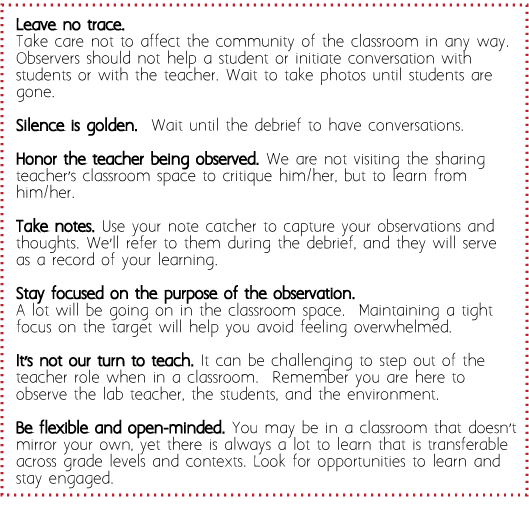
Norms for observations (from MHouser's Blog):

These were shared with teachers just to ensure that the classroom visits were as respectful and productive as possible.
agenda-4


Studio Weeks:
Dates: Week of October 4, November 15, January 24, April 11, and May 16 (tentative).

June Studio Notes:
  • The studio is everyone's classroom!
  • The studio is everyone's week, providing for everyone's learning.
  • Teachers will leave with both a collective and personal goal. (Goals should be connected to the Essential Questions.)
  • Goals will be measured in three ways: 1) Teacher and Student's behaviors, 2) Teacher and Student's ability to articulate learning, 3) Teacher and Student's access to content.
  • Goals could be formatted like, "If I _______, my students will be able to ______." Please note the connection to PDSA goals and "purpose" and "student engagement" from the 5 dimensions. This speaks to both teacher practice and student behaviors.
  • Our CEL work will fill in the Teacher and Student practice and Curriculum pieces of the JHMS Essential Question and Instructional Core Working Document (below).
Monday and Tuesday will be the JHMS LA Studio Days. During these days, studio teachers co-plan and then teach with Jenn in their classrooms. During these days, all teachers will study content, co-plan, observe, debrief (reflect, adjust, plan), and create goals for the follow up "coaching cycle" with Michelle.
Wednesday and Thursday will be the JHMS MATH Studio Days. During these days, studio teachers co-plan and then teach with Dorothy in their classrooms. During these days, all math teachers will study content, co-plan, observe, debrief (reflect, adjust, plan), and create goals for the follow up practice.
Studio weeks will be followed up with in-house Coaching Cycles.

JHMS Essential Question and Instructional Core Working Document:
Essential Question: How does JHMS improve reading achievement for all students? How do we challenge all students to be critical readers (another definition)? (Critical readers should be able to provide details and arguments to support interpretations of what they read from the text.)
Rationale: We are going to leverage what we know about writing to our teaching of reading. We feel that focusing on improving reading achievement AND critical reading allows us to differentiate our PD for all teachers and students (those who are already proficient and need a push to advanced).
Shared Teacher Practice (brainstormed in June): PDSA weeklyish cycles, UBD, Flexible groups - differentiation, SIOP, Sheltered Instruction - SIOP, Collaborative practices, Assessment practices (including differentiation for ELL and SpEd students), Marzano's strategies...
LA Teachers: Reading conferences (leveraging what we do during writing conferences),
Content Area Teachers: Focus on literacy across content areas using Expository Text Structures, QAR & PQPA, Reciprocal reading/SQ3R
Measured by TEACHER behaviors, articulation, and access/understanding.
Shared Student Learning (brainstormed in June): Use of reading strategies independently in all classrooms both when reading and talking, goal setting, fluency, self-efficacy, increased reading volume/interest/motivation, self-selected vocabulary and independent use of vocabulary strategies...
Measured by STUDENT behaviors, articulation, and access/understanding of content.
Curriculum Development and Support: UBD, IF, Media Center, Collaboration with support staff, classroom libraries, updated materials ...

Year 1 - District Outcomes for CEL work:
1. To develop shared practices based on our vision of our students as readers, writers, and thinkers. (Evidence: In classroom observations, we see participants applying shared practices. The vision document may be refined through collective learning.)
2. To engage in a professional development studio residency model that supports continuous improvement, collaborative inquiry, and instructional leadership. (Evidence: Through observation and CI plans, TCSD participants will be able to discuss, practice, question, and reflect on current practice. Leadership CI plans will reflect alignment with literacy work. Participants use processes and procedures for CI in other settings, such as team meetings.)
3. To develop effective collaboration among classroom, Special Education, English Language Learner, Title 1 teachers with support from instructional facilitators and district and building leadership. (Evidence: Participants use processes and procedures that collaboratively develop CI cycles. Leadership provides time and support for CI plan development by participants.)
4. To develop system coherence around the instructional core (Tier 1) as the foundation for literacy. (Evidence: TBD.)
Theory of Action: If we meet these four goals, all student will improve as readers, writers, and critical thinkers as defined by our literacy vision.

NOTE:   Bo explained the district agreed to 3 years with CEL.  The goal at JHMS is every teacher is involved with CEL work by the end of the 3 years.  This will become the norm of new teacher training.